How to make pour over coffee at home

For pour over coffee, use 1 g of coffee for every 16 to 17 g of water, ground medium-fine. Wet the grounds, wait 30 to 45 seconds, then pour the rest in stages over 3 to 4 minutes.

Tap the dripper to brew again

At a glance

Ratio
1:16 to 1:17
Grind
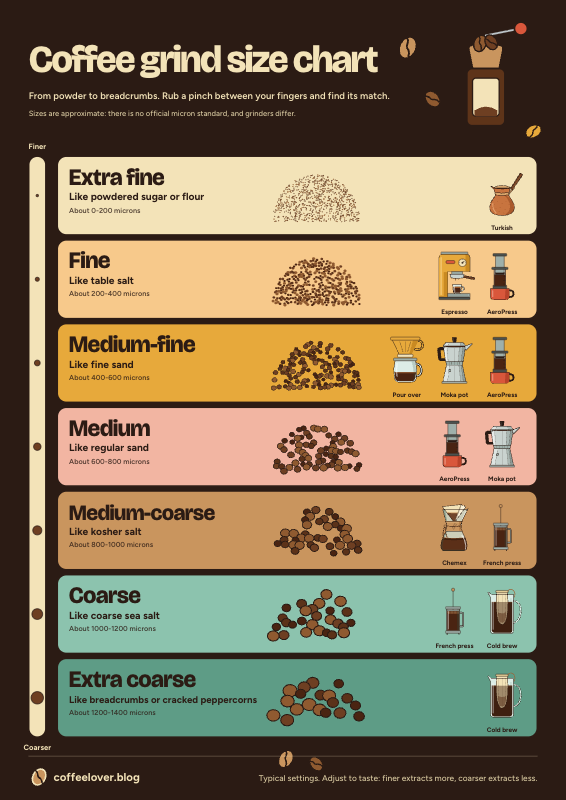
Medium-fine, like table salt
Water
195 to 205 °F
Bloom
Twice the coffee's weight
Time
3 to 4 minutes

What you need

Get a dripper, paper filters, a kettle and a kitchen scale. Drippers come in two common shapes, cone and flat bottom. Counter Culture finds the flat-bottom kind easier to get right, and says a cone gives a bit more clarity of flavor. A gooseneck kettle lets you aim a thin stream. First, rinse the filter with hot water to wash out the paper taste and warm your mug.

Ratio and grind

Start at 1:16 to 1:17, coffee to water by weight. Counter Culture uses 1:17 as its standard. Stumptown pairs 21 g of coffee with 360 g of water for a 10 oz mug. Grind to medium-fine, about the size of table salt. For a Chemex, grind coarser, closer to kosher salt. A finer grind slows the water down, and a coarser one lets it through faster.

How much coffee for your mug, at 1:16 and 1:17
Small mug10 oz mugTwo mugsFull Chemex
Water250 g360 g500 g700 g
Coffee at 1 : 1616 g23 g31 g44 g
Coffee at 1 : 1715 g21 g29 g41 g
The grounds hold back some water: 360 g of water gives about 10 oz of coffee.

The bloom

Wet the grounds with about twice their weight in water: 30 g for 15 g of coffee. Coffee keeps giving off carbon dioxide for about two weeks after roasting. The gas tastes sour and pushes water away, so the bed puffs up and bubbles. Give it 30 to 45 seconds to escape. Recipes disagree on the wait: Stumptown's cone recipe moves on after 15 seconds.

Pouring in stages

Add the rest of the water in three or four equal pours. Move the spout in a slow spiral from the center out. Counter Culture keeps the dripper between half and two-thirds full. In one popular one-cup recipe, you add 50 g at a time, every 20 to 25 seconds, until the scale reads 250 g. Finish with a gentle swirl of the dripper.

Timing and taste

From the first pour to the last drip, plan on 3 to 4 minutes. If the brew drains in 2 minutes, grind finer. At 5 minutes, go coarser. Then taste. A sour cup means the water pulled out too little, so grind finer or brew longer. If it tastes bitter, do the opposite. Change one thing at a time so you know which change worked.

Questions people ask

What grind size is best for pour over coffee?

Medium-fine, like table salt or fine sand. Roasters describe it in different ways: Stumptown compares its cone grind to kosher salt and its flat-bottom grind to sea salt. For a Chemex, go a little coarser.

How much coffee do you need for one cup of pour over?

Between 15 and 21 g. One popular recipe uses 15 g for 250 g of water. Stumptown uses 21 g, about 3 tablespoons, for a 10 oz mug. With no scale, try 1 tablespoon per 4 oz of water.

What water temperature should you use for pour over?

195 to 205 °F, or about 90 to 96 °C. Water a moment off the boil sits in that range. For light roasts, some recipes use water at 100 °C (212 °F).

Do you need a gooseneck kettle for pour over?

It helps, but opinions differ. Counter Culture calls it essential: the thin spout lets you control the flow and aim the water. Majesty Coffee, a retailer, says a regular kettle can still make a good cup.

More ways to brew

Found this useful?Everything on coffeelover is free, no ads and no paywall. If this page helped you, a coffee keeps me drawing the next batch.

Buy me a coffee

Sources

11
  1. Guide to pour-over coffee Counter Culture
  2. Coffee basics: brewing ratios Counter Culture
  3. Brew guide: Hario V60 Stumptown
  4. Brew guide: Kalita Wave Stumptown
  5. Brew guide: Chemex Stumptown
  6. James Hoffmann's 1-cup V60 technique Hario USA
  7. James Hoffmann's V60 recipe Honest Coffee Guide
  8. What is the bloom? Driftaway Coffee
  9. Gooseneck kettle Majesty Coffee
  10. Understanding coffee extraction Perfect Daily Grind
  11. Coffee grind size chart Honest Coffee Guide